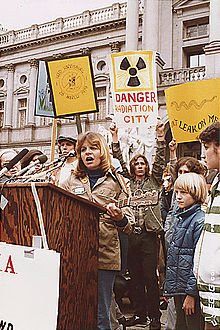
Anti-nuclear protest at Harrisburg in 1979, following the Three Mile Island Accident.
A large
anti-nuclear demonstration was held on May 6, 1979, in Washington D.C., when 125,000 people
[2] including the Governor of California, attended a march and rally against
nuclear power.
[3] In New York City on September 23, 1979, almost 200,000 people attended a protest against nuclear power.
[4] Anti-nuclear power protests preceded the shutdown of the
Shoreham,
Yankee Rowe,
Millstone I,
Rancho Seco,
Maine Yankee, and about a dozen other nuclear power plants.
[5]
On May 1, 2005, 40,000 anti-nuclear/anti-war protesters marched past the United Nations in New York, 60 years after the
atomic bombings of Hiroshima and Nagasaki.
[13][14] This was the largest anti-nuclear rally in the U.S. for several decades.
[15] In the 2000s there were protests about, and campaigns against, several new nuclear reactor proposals in the United States.
[16][17][18] In 2013, four aging, uncompetitive, reactors were permanently closed: San Onofre 2 and 3 in California, Crystal River 3 in Florida, and Kewaunee in Wisconsin.
[19][20] Vermont Yankee, in Vernon, is scheduled to close in 2014, following many protests. Protesters in New York State are seeking to close
Indian Point Energy Center, in Buchanan, 30 miles from New York City.
[20]
Background[edit]
The
anti-nuclear movement in the United States have undertaken public
protests and acts of
civil disobedience which have included occupations of nuclear plant sites. Other salient strategies have included lobbying, petitioning government authorities, influencing
public policy through referendum campaigns and involvement in elections. Anti-nuclear groups have also tried to influence policy implementation through litigation and by participating in licencing proceedings.
[21]
Bodega Bay[edit]
Women Strike for Peace[edit]
Montague Nuclear Power Plant[edit]
On 22 February 1974, Washington's Birthday, organic farmer Sam Lovejoy took a crowbar to the weather-monitoring tower which had been erected at the
Montague Nuclear Power Plant site. Lovejoy felled 349 feet of the 550 foot tower and then took himself to the local police station, where he presented a statement in which he took full responsibility for the action. Lovejoy's action galvanized local public opinion against the plant.
[26][27] The Montague nuclear power plant proposal was canceled in 1980,
[28] after $29 million was spent on the project.
[26]
Seabrook Station Nuclear Power Plant[edit]
Seabrook power plant was proposed as a twin-reactor plant in 1972, at an estimated cost of $973 million. When it finally won a commercial license in March 1990, it was a single reactor which cost $6.5 billion.
[29] Over a period of thirteen years more than 4,000 citizens, many associated with the
Clamshell Alliance anti-nuclear group, committed non-violent civil disobedience at Seabrook:
[30]
- August 1, 1976: 200 residents rallied at the future Seabrook Station Nuclear Power Plant site in New Hampshire, and 18 were arrested for criminal trespass.[30]
- August 22, 1976: 188 activists from New England were arrested at the Seabrook site.[30][31]
- May 2, 1977: 1,414 protesters were arrested at Seabrook Station Nuclear Power Plant.[5][32][33] The protesters who were arrested were expected to be "released on their own recognizance", but this did not happen. Instead, they were charged with criminal trespass and asked to post bail ranging from $100 to $500. They refused and were then held in five national guard armories for 12 days. The Seabrook conflict, and role of New Hampshire Governor Meldrim Thomson, received much national media coverage.[34]
- May 13, 1977: 550 protestors were freed after being detained for thirteen days.[35]
- June 1978: some 12,000 people attended a protest at Seabrook.[5][33]
- May 25–27, 1980: Police use tear gas, riot sticks and dogs to drive 2,000 demonstrators away from the Seabrook site.[36]
- May 24, 1986: 74 anti-nuclear demonstrators were arrested in protests.[37][38]
- October 17, 1988: 84 people were arrested at the Seabrook plant.[39]
- June 5, 1989: hundreds of demonstrators protested against the plant's first low-power testing, and the police arrested 627 people for trespassing; two state legislators, one from Massachusetts and one from New Hampshire, protested.[30][40]
Diablo Canyon Power Plant[edit]
Seabrook's Clamshell Alliance inspired the formation of California's
Abalone Alliance, a coalition that included sixty member groups by 1981. The Abalone Alliance staged blockades and occupations at the Diablo Canyon Power Plant site between 1977 and 1984.
[41] Nearly two thousand people were arrested during a two-week blockade in 1981, exceeding Seabrook as the largest number arrested at an anti-nuclear protest in the United States.
[41] Specific protests included:
- August 6, 1977: The Abalone Alliance held the first blockade at Diablo Canyon Power Plant in California, and 47 people were arrested.[42]
- August 1978: almost 500 people were arrested for protesting at Diablo Canyon.[42]
- April 8, 1979: 30,000 people marched in San Francisco to support shutting down the Diablo Canyon Power Plant.[43]
- June 30, 1979: about 40,000 people attended a protest rally at Diablo Canyon.[44]
- September 1981: close to 2,000 arrests were made during attempted occupation of Diablo Canyon.[42][45]
- May 1984: about 130 demonstrators showed up for start-up day at Diablo Canyon, and five were arrested.[46]
In April 2011, there was demonstration of 300 people at Avila Beach calling for the closure of Diablo Canyon nuclear power plant and a halt to its relicensing application process. The event, organized by San Luis Obispo-based anti-nuclear group
Mothers for Peace, was in response to the
Fukushima nuclear disaster in Japan.
[47]
Trojan Nuclear Power Plant[edit]
There was opposition to the
Trojan Nuclear Power Plant from its inception, and this included non-violent protests organized by the
Trojan Decommissioning Alliance. The Alliance organized the first major
direct action protest at Trojan in August 1977, and a second round of protests took place that November. Scores of demonstrators were arrested, and in December 1977 a jury found 96 protesters not guilty of criminal trespass. There was another protest in August 1978, which led to about 280 arrests.
[48] In the 1980s and early 1990s, Portland activist Lloyd Marbet and his group, Forelaws on Board, "became Trojan's leading opponents".
[48]
Washington events, August 1985[edit]

Each of the 2,500 pews in the cathedral was covered with a cloth panel, decorated by
The Ribbon International anti-nuclear group.
The interfaith service for peace and nuclear disarmament, held on August 3 at the
Washington National Cathedral, was attended by 5,000 people. Cathedral staff reported that it was the second-largest crowd ever hosted in the building. Over 4,000 handmade cloth panels were on display during the service. Each pew was decorated by
The Ribbon International group, and additional cloth ribbons were draped and tied in various locations around the building. Twenty bagpipers in Highland dress led a procession of 200 people carrying ribbons into the cathedral. The service also included dancing, meditation, and a performance by the
Howard University Gospel Choir.
[50][51] Survivors of the Hiroshima and Nagasaki bombings were in attendance both at the church service and during The Ribbon event the next day.
When all 27,000 individual cloth panels were joined together on August 4, it created a ribbon 18 miles (29 km) long.
[52] Don Wilcox of
The Craft Report described it as "the largest collaborative craft event in American history".
[53] The Ribbon wrapped around the Pentagon building, through the Pentagon parking lot, down the foot paths alongside the
Jefferson Davis Highwayand
Washington Boulevard, crossed the
Potomac River into Washington D.C. at the
Arlington Memorial Bridge, and travelled into the
National Mall area. The Ribbon then went past the
Lincoln Memorial, along the south side of the
Lincoln Memorial Reflecting Pool, continuing east along the National Mall, and around the U.S.
Capitol Building. It then turned west along the north side of the National Mall, went around the Ellipse by the White House, passed the Lincoln Memorial, crossed the Potomac River again and returned to the Pentagon. When the chain of panels was completed, hundreds of balloons were released near the Lincoln Memorial. The entire route was lined with people, and crowds gathered at the three designated speaking areas (the Pentagon, the Lincoln Memorial, and the Capitol). Singers, including
Pete Seeger and
Tom Chapin, rotated between the three stage areas, performing anti-war songs.
[54]
Three Mile Island accident[edit]
Even before the
Three Mile Island accident, the nuclear industry was facing considerable adverse public opinion. A "sizeable and tenacious opposition movement had caused significant delays" in the licensing and construction of new power plants in the United States. The TMI accident stimulated a rise in anti-nuclear sentiment.
[56]
The American public were concerned about the release of radioactive gas from the Three Mile Island accident and many mass demonstrations opposing nuclear power took place across the country in the following months. The largest one was held in New York City in September 1979 and involved two hundred thousand people; speeches were given by
Jane Fonda and
Ralph Nader.
[4][57][58] The New York rally was held in conjunction with a series of nightly “
No Nukes” concerts given at
Madison Square Garden from September 19 through 23 by
Musicians United for Safe Energy.
In the previous May, an estimated 65,000 people, including the Governor of California, attended a march and rally against nuclear power in Washington, D.C.
[3][43]
Black Fox Nuclear Power Plant[edit]
Shoreham Nuclear Power Plant[edit]
- August 12, 1978: Forty protesters are arrested at the first anti-Shoreham demonstration.[62][63]
- 1989: after many years of protests, the completed Shoreham plant was closed without generating any commercial electrical power.[64][66]
Rocky Flats Nuclear Weapons Plant[edit]
- April 28, 1979: 15,000 people demonstrated against the Rocky Flats Nuclear Weapons Plant, making the link between nuclear power and nuclear weaponry.[67][68]
- October 15, 1983: Large demonstration at Rocky Flats.[69][70]
- August 10, 1987: 320 demonstrators were arrested after they tried to force a one-day shutdown of the Rocky Flats nuclear weapons plant.[71]
- August, 1989: An estimated 3,500 people turned out for a demonstration at Rocky Flats.[70]
Rancho Seco Nuclear Power Plant[edit]
In 1979, Abalone Alliance members held a 38-day sit-in at Californian Governor
Jerry Brown's office to protest continued operation of
Rancho Seco Nuclear Generating Station, which was a duplicate of the Three Mile Island facility.
[72] In 1989, Sacramento voters voted to shut down the Rancho Seco power plant.
[73]
Protest against the Arms Race[edit]
Seneca Women’s Peace Camp[edit]
The
Seneca Women's Encampment for a Future of Peace and Justice was located in
Romulus, in
Seneca County, New York, adjacent to the
Seneca Army Depot. It took place mainly during the summer of 1983. Thousands of women came to participate and rally against nuclear weapons and the “
patriarchal society” that created and used those weapons. The purpose of the Encampment was to stop the scheduled deployment of Cruise and Pershing II missiles before their suspected shipment from the Seneca Army Depot to Europe that fall. The Encampment continued as an active political presence in the Finger Lakes area for at least 5 more years, supporting anti-nuclear education and the connections between eco-feminism, non-violence, the need for civil disobedience and ideas of perma-culture, and sustainability.
Vermont Yankee Nuclear Power Plant[edit]
- September 23, 1979: some 167 protesters were arrested at Vermont Yankee Nuclear Power Plant.[33]
- January 2006: 100 anti-nuclear supporters demonstrated at the front door of Entergy Nuclear, and eleven people were arrested for trespassing.[75][76]
- October 2006: 26 people were arrested outside the Brattleboro offices of owner Entergy Nuclear; the demonstration drew about 200 people.[77][78]
- April 27, 2007: Seven anti-nuclear activists were arrested after chaining themselves to a fence at Vermont Yankee nuclear power plant. The protesters, who call themselves the "Raging Grannies", wanted the plant shut down and have engaged in dozens of similar actions since December 2005.[79]
- November 2008: About 15 people held a rowdy protest against Vermont Yankee in the offices of the Public Service Board that regulates utilities.[80][81]
- April 2009: A rally and two full-page advertisements in The Burlington Free Press, which mocked the Vermont Yankee Power Plant, were paid for by a newly formed group, The Clean Green Vermont Alliance.[82]
- April 2009: About 150 activists marched from Montpelier's City Hall to the State House to urge lawmakers to back development of clean energy sources such aswind power and solar power; the marchers had gathered 12,000 signatures in support of closing Vermont Yankee.[83][84]
- September 2009: Frances Crowe and three other women were arrested for non-violent civil disobedience at the Vermont Yankee nuclear power plant.[85]
- January 2010: A coalition of anti-nuclear activists participated in a 126-mile walk from Brattleboro to Montpelier in an effort to block the re-licensing of Vermont Yankee. About 175 people took part in the March, some joining for the day and some for longer stretches.[86]
- On February 24, 2010, a large number of anti-nuclear activists and private citizens gathered in Montpelier to be at hand as the Vermont Senate voted 26 to 4 to not issue the Vermont Yankee reactor the "Public Good" certificate it needed for continued operation past 2012. Under Vermont law the re-license would have to be approved by both houses to continue operation.[87]
- March 2011: 600 people gathered for a weekend protest outside the Vermont Yankee plant. The demonstration was held to show support for the thousands of Japanese people who are endangered by possible radiation from the Fukushima I nuclear accidents.[88]
- March 2012: More than 130 protesters were arrested at the corporate headquarters of the Vermont Yankee nuclear power plant, on the first day of the plant's operation after the expiration of its original 40-year license.[89]
- March 2013: More than 500 people, carrying banners and chanting "shut it down", marched through downtown Brattleboro in protest against Vermont Yankee.[90]
On August 27, 2013, Entergy announced in a press release that it would close Vermont Yankee by the end of 2014.
[91]
San Onofre Nuclear Generating Station[edit]
- August 6, 1977: about a thousand anti-nuclear protesters marched outside the San Onofre nuclear generation station, while units 2 & 3 were under construction.[92]
- June 22, 1980: about 15,000 people attended a protest near San Onofre Nuclear Generating Station in California.[33]
- March 2012: 200 activists protested the San Onofre Nuclear Generating Station to mark the one-year anniversary of the nuclear meltdowns in Fukushima, Japan.[93]
On June 7, 2013, Southern California Edison announced it would "permanently retire" Unit 2 and Unit 3, ending their attempt to restart the plant at a reduced capacity.
[94]
Lawrence Livermore National Laboratory[edit]
The Livermore Action Group organized many mass protests, from 1981 to 1984, against nuclear weapons which were being produced by the Lawrence Livermore National Laboratory. Peace activists Ken Nightingale and Eldred Schneider were involved.
[95] On June 22, 1982, more than 1,300
anti-nuclear protesters were arrested in a nonviolent demonstration.
[96] More recently, there has been an annual protest against nuclear weapons research at Lawrence Livermore. In August 2003, 1,000 people protested at Livermore Labs against "new-generation nuclear warheads".
[97] In the 2007 protest, 64 people were arrested.
[98] More than 80 people were arrested in March 2008 while protesting at the gates.
[99]
International Day of Nuclear Disarmament[edit]
International Day of Nuclear Disarmament protests were held on June 20, 1983 at 50 sites across the United States. Many of the protests were against corporations involved in nuclear weapons production. Almost a thousand members of the Livermore Action Group were arrested at one demonstration.
[8][9]
Great Peace March for Global Nuclear Disarmament[edit]
Yankee Rowe Nuclear Power Plant[edit]
Nevada Test Site[edit]

Members of
Nevada Desert Experience hold a prayer vigil during the Easter period of 1982 at the entrance to the Nevada Test Site.
From 1986 through 1994, two years after the United States put a hold on full-scale
nuclear weapons testing, 536 demonstrations were held at the
Nevada Test Site involving 37,488 participants and 15,740 arrests, according to government records.
[101]These are just a few details:
- January, 1987: The actor Martin Sheen and 71 other anti-nuclear protesters were arrested at the Nevada Test Site in a demonstration marking the 36th anniversary of the first nuclear test there.[102]
- February 5, 1987: More than 400 people were arrested, when they tried to enter the nation's nuclear proving grounds after nearly 2,000 demonstrators held a rally to protest nuclear weapons testing. Those arrested included the astronomer Carl Sagan and the actors Kris Kristofferson, Martin Sheen, and Robert Blake. Five Democratic members of Congress attended the rally: Thomas J. Downey, Mike Lowry, Jim Bates, Leon E. Panetta and Barbara Boxer.[11][103]
- August 9, 1987: A total of 228 people demonstrating against nuclear weapons were arrested at the Nevada Test Site.[71]
- September 30, 1987: 110 demonstrators, including seven pediatricians, were arrested for civil disobedience; charges were later dropped.[104]
- March 20, 1989: 75 protesters, including Louis Vitale, were arrested for trespassing in a peaceful Palm Sunday demonstration.[105]
- April 20, 1992: 493 anti-nuclear protesters were arrested on misdemeanor charges, as demonstrators clashed with guards at an annual Easter demonstration against weapons testing at the remote desert site.[12]
- August 6, 1995: 500 people gathered to mark the fiftieth anniversary of the bombing of Hiroshima.[106]
- 1997: Over 2,000 people turned out for a demonstration and 700 were arrested.[107]
- August 2005: About 200 peace activists, including actor Martin Sheen, gathered for a nonviolent demonstration outside the gates; dozens were given citations and released after crossing police lines.[108]
- May 2006: 200 activists protested the Divine Strake explosives test, and 40 were arrested.[109]
- April 2007: Nevada Desert Experience protest, where 39 people were cited by police.[110]
Y-12 Weapons Plant[edit]
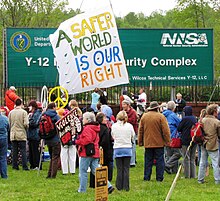
April 2011 OREPA rally at the Y-12 entrance
Since 1988, Oak Ridge Environmental Peace Alliance has organized non-violent direct action protests at the
Y-12 National Security Complex, in an effort to close down the weapons plant. Sister Mary Dennis Lentsch, a Catholic nun, has been arrested many times for protesting at the Oak Ridge facility. She has said, "I believe the continuing weapons production at the Y-12 National Security Complex in Oak Ridge, Tennessee, is in direct violation of the treaty obligations of the United States and consequently, is a violation of Article 6 of the US Constitution”.
[111] In 2011,
Rev. Bill Bichsel, an 84-year-old priest, received a prison sentence of three months for trespassing on federal property at the Y-12 complex.
[112] In 2012, there have been protests about the proposed new Uranium Processing Facility, which is expected to cost $7.5 billion.
[113]
In July 2012,
Megan Rice, an 82-year-old nun and two fellow pacifists entered the Y-12 complex and spray-painted antiwar slogans on a building that houses nuclear bomb fuel. The anti-nuclear activists, who got past fences and security sensors before dawn on July 28, spent several hours in the Complex, conducting a Christian peace ritual, before they were stopped by a lone guard. The security breach prompted private experts to criticize the Department of Energy’s safeguarding of nuclear stockpiles. The agency is to reappraise security measures across its nuclear weapons program.
[114]
Naval Base Kitsap[edit]
- January 19, 2008: Seventeen people protesting about nuclear weapons at Naval Base Kitsap at Bangor in honor of Martin Luther King. Jr. were detained or arrested. All were released shortly afterward.[116]
- May 30, 2008: Twelve people were arrested at an anti-nuclear weapon demonstration at Naval Base Kitsap-Bangor — five of them for walking on a sidewalk closed to pedestrian traffic.[117]
- November 2, 2009: Five protestors, including Jesuit Priest William J. Bichsel, S.J. were arrested for breaking through two levels of security to protest the nuclear weapons stored at the base. The protesters walked to a bunker where the weapons were stored and spilled blood, hung posters and prayed.[118]
White House Peace Vigil[edit]
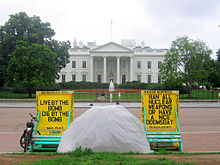
The White House Peace Vigil, June 2006


